Munich Airport (MUC) is efficient and well signed, but ski equipment takes a different path through it from the rest of your luggage, and the two terminals behave differently. Knowing which arrivals hall you will walk into saves more time than anything else you can plan.
Terminal 1 or Terminal 2: it matters on arrival
Terminal 2 handles Lufthansa, Swiss, Austrian and the rest of the Star Alliance, plus Eurowings. Terminal 1 handles most other carriers, including British Airways, easyJet, Ryanair and Wizz Air, and is divided into modules A to E with separate exits.
Terminal 2 arrivals funnel into one broad, obvious hall. Terminal 1 does not: each module has its own exit, and a driver waiting at module D is a ten-minute walk from a passenger standing at module B. If you are being met, the module is worth knowing; it is on your boarding pass.
Where ski and board bags actually appear
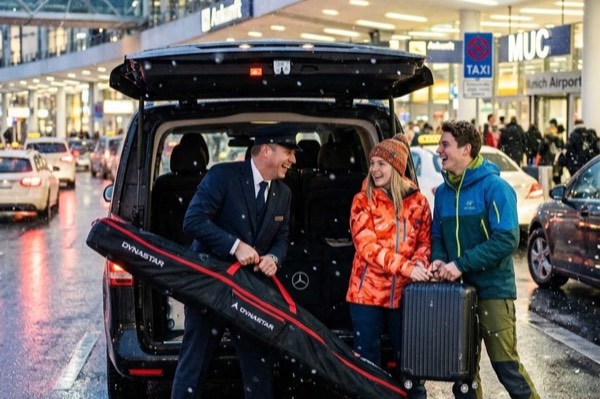
Oversized and special baggage does not use the standard carousels. At Munich it is released at a separate bulky baggage point in the same baggage hall, usually at one end, signed "Sperrgepäck" or "Bulky Baggage".
Two practical consequences. First, someone in the party should go straight there rather than everyone waiting at the carousel. Second, bulky baggage is frequently slower than the suitcases — 10 to 25 minutes after the first case appears is normal, and on a busy Saturday it can be longer.
- Check the bulky baggage point before assuming a bag is lost; it is the single most common false alarm.
- Soft ski bags are handled more roughly than hard cases. Pack boots separately if you can.
- Photograph your bags at check-in. It makes a claim much faster if one does go missing.
How much time to allow after landing
From wheels down to standing outside with all your luggage, on a normal winter weekday:
| Schengen arrival | Non-Schengen arrival | |
|---|---|---|
| Taxi to stand, disembark | 10–15 min | 10–15 min |
| Walk to baggage hall | 5–10 min | 10–15 min |
| Passport control | none | 15–40 min |
| Suitcases on the belt | 15–25 min | 15–25 min |
| Ski bags at bulky baggage | +10–25 min | +10–25 min |
| Realistic total | 40–60 min | 60–95 min |
Saturdays in January and February are the worst of the season: the whole of the Alps changes over on the same day, and both the baggage hall and the roads south feel it. Add half an hour to anything you have planned.
Meeting a driver
Private drivers wait inside the arrivals hall with a name sign, after customs. That is the simplest arrangement and the one to insist on — kerbside pick-up at Munich means a short-stay car park and a phone call, which is exactly what nobody wants after a 6am flight with three children.
Give the flight number when you book, not just a time. A driver working from a flight number sees the delay before you have landed; one working from a clock time is sitting in a car park wondering.
Before you leave the hall
- Buy any Austrian or Swiss motorway vignette here if you are driving yourself — the airport shops sell them, and the first petrol station over the border will have a queue.
- Use the washrooms. The next reliable stop is 90 minutes away.
- If you are hiring equipment at the resort, this is the moment to confirm your collection time, before you are in a valley with no signal.