Munich Airport sits 30 km north-east of the city, on the wrong side of it for the mountains. Whatever you choose, the first hour is spent getting around Munich rather than towards the Alps — which is why comparisons based on map distance tend to mislead.
There are four realistic options. None of them is best for everyone; they fail in different ways.
The train: cheap, scenic, and three changes
There is no direct rail link from Munich Airport to any alpine resort. Every journey starts with the S1 or S8 S-Bahn into the city — about 45 minutes to the Hauptbahnhof — and continues from there.
From the Hauptbahnhof the railway is genuinely good. Innsbruck is under two hours by ÖBB Railjet. Salzburg is an hour and a half. Both are comfortable, frequent and cost a fraction of anything else on this list.
The difficulty is the last leg. Kitzbühel, Sölden, Ischgl and St. Anton are not on a main line, or the station is a long way below the village. A typical airport-to-chalet journey means the S-Bahn, a long-distance train, a regional train and a bus or taxi — four changes, each with luggage, each with a connection to miss.
- Best for: solo travellers and couples travelling light, to Innsbruck or Salzburg.
- Worst for: families, groups, anyone with ski bags, and anyone arriving after about 20:00.
- Plan for 4–6 hours door to door to a resort, 2.5–3 hours to Innsbruck city.
The scheduled ski bus: cheap per seat, fixed departures
Seasonal coach services run from Munich Airport to the larger Tyrolean resorts on winter Saturdays. Per person they are the cheapest way to reach a resort door, and the luggage is handled for you.
The catch is the timetable. A coach leaves when it leaves. If your flight lands 90 minutes late — common enough in January — the coach has gone, and the next one may be the following day. Services also concentrate on Saturdays, which is useless if your trip starts midweek.
Rental car: freedom, and a longer to-do list than people expect
A rental car is the obvious answer until you price the whole thing. The rental itself is only the first line.
- Winter tyres are a legal requirement in Austria in wintry conditions, and rental companies charge for them.
- Snow chains may be required on marked sections; carrying them is on you.
- An Austrian motorway vignette is needed the moment you cross the border.
- Resort parking is often paid, and in some villages severely limited.
- Cross-border fees apply if you pick up in Germany and drive into Switzerland or Italy.
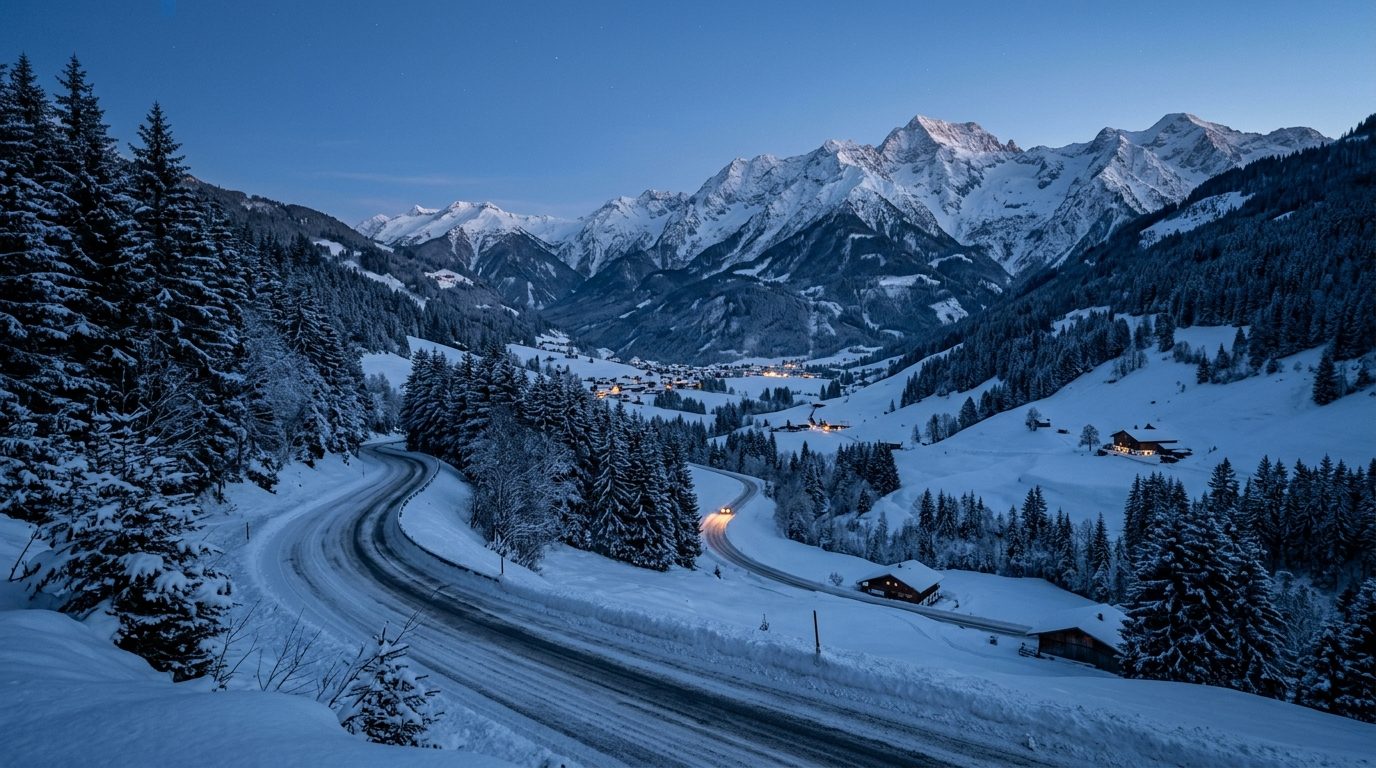
Add those up and a week's rental frequently costs more than a return private transfer for four people — before anyone has driven an unfamiliar car up an iced valley road in the dark after a 6am flight.
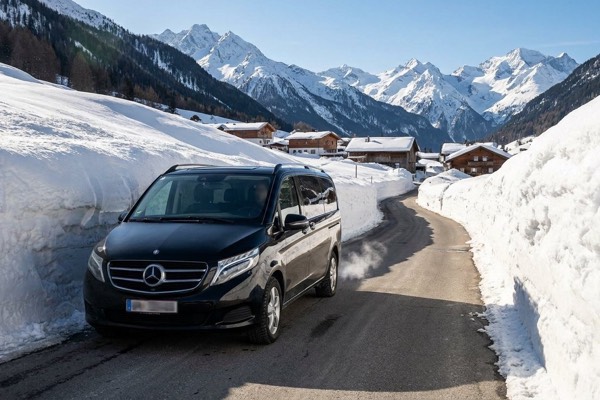
A car does make sense if you plan to move between resorts, or if your accommodation is genuinely remote. For a single-resort week it is usually an expensive way to leave a vehicle in a car park for six days.
Private transfer: the expensive-looking one that often is not
A private transfer is quoted per vehicle, not per person. That single fact changes the arithmetic completely, and it is the thing most comparisons get wrong.
A fixed fare of €300 to Kitzbühel is €300 whether one person travels or four. Split four ways it is €75 each — comparable to the train once you add the connecting taxi, and without the changes.
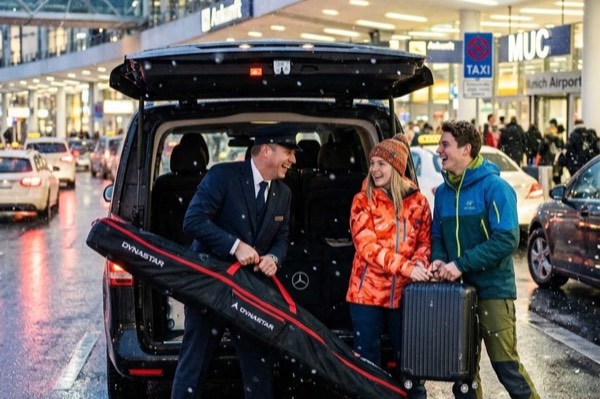
The other difference is what happens when the flight is late. A transfer booked against your flight number is tracked; the driver waits for the actual landing time. A coach does not wait, and a rental desk may well be closed.
- Best for: groups of three or more, families, anyone with ski equipment, late arrivals, and remote accommodation.
- Worst for: a single traveller on a tight budget heading to a city on a main line.
A rough comparison
| Train | Ski coach | Rental car | Private transfer | |
|---|---|---|---|---|
| Priced by | person | person | vehicle + extras | vehicle |
| Door to door | no | resort centre | yes | yes |
| Waits for a late flight | next train | no | desk hours | yes |
| Ski luggage | you carry it | included | your boot | included |
| Good for groups | no | reasonable | yes | yes |
How to decide in one minute
Count your party and your bags. One or two people, light luggage, heading to Innsbruck or Salzburg: take the train. A Saturday arrival, a big resort, and a tight budget: the coach is worth checking. Moving between valleys all week: rent a car. Three or more people, skis, or a flight landing after dark: a transfer will be cheaper than it looks and considerably less work.
Our own prices are fixed per vehicle and published per route, so you can do that arithmetic before booking anything.